The Number Doesn't Lie — But It Doesn't Tell the Whole Truth Either
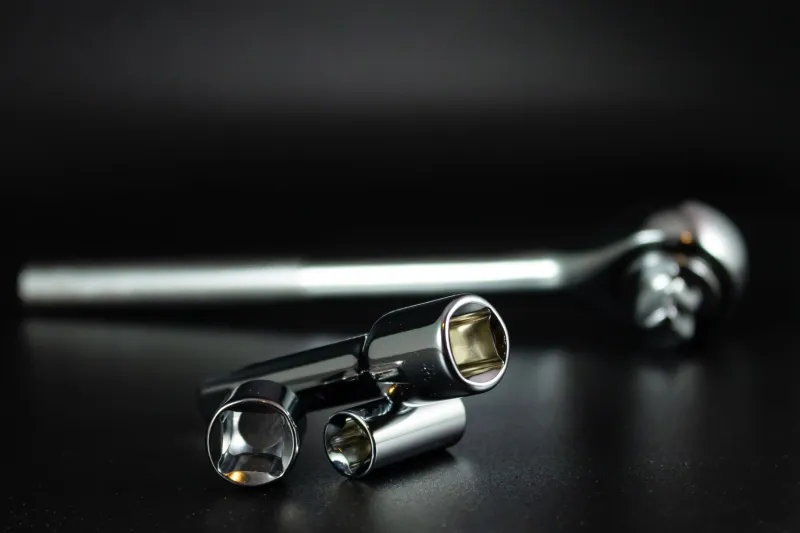
You clicked at 85 ft-lbs. The spec said 85 ft-lbs. Job done, right?
Not quite. That click told you how much rotational resistance you applied to the fastener. It did not tell you how tightly the joint is actually clamped together — and those two things are way less connected than most mechanics realize.
This isn't a knock on torque wrenches. A quality click-style or digital wrench is still one of the most important tools in any serious shop. But there's a growing awareness among professional engine builders and racing engineers that torque measurement is really just a proxy for what you actually care about: clamping force. And depending on a dozen different variables, that proxy can be off by 30% or more in either direction.
Let's dig into why.
What You're Actually Trying to Achieve
When you torque a bolt, the goal isn't to hit a number. The goal is to stretch the fastener — elastically, just enough — so that it acts like a spring, pulling the joint faces together with a specific and consistent clamping load. That tension is what keeps your head gasket sealed, your rod bolts from walking, and your wheel studs from backing out under load.
Torque is just the input. Clamping force is the output. And the relationship between them is governed by a friction coefficient that varies constantly based on conditions you can't always control.
The basic equation engineers use is: T = K × D × F, where T is applied torque, D is bolt diameter, F is the desired clamping force, and K is the so-called "nut factor" — a dimensionless number that accounts for all the friction happening between the bolt head, threads, and mating surfaces.
Here's the problem: K isn't a constant. It moves around depending on surface finish, plating, lubrication, material hardness, and even how many times the fastener has been used before. On a clean, lightly oiled Grade 8 bolt, K might be around 0.15. On a dry, zinc-plated fastener, it could push past 0.20. That doesn't sound like much until you realize that variation alone can swing your actual clamping force by 25 to 35 percent — while your wrench clicks at exactly the right number every single time.
The Lubricant Variable Nobody Talks About
Anti-seize is probably the most misunderstood product in a mechanic's cabinet. It's genuinely useful for preventing galling and corrosion on certain fasteners, but applying it without adjusting your torque spec is a recipe for over-clamping.
Anti-seize dramatically lowers the friction coefficient at the thread interface. If your torque spec was written assuming a dry or lightly oiled fastener, and you slather on anti-seize without compensating, you're applying significantly more clamping force than the engineer intended. Depending on the compound, you may need to reduce your torque value by 10 to 25 percent to land at the same preload.
Same story in reverse with thread-locking compounds. Certain anaerobic locktites increase friction during installation, meaning you might be under-clamping while the wrench says you're right on spec.
Most factory service manuals specify whether a fastener should be installed dry, with engine oil, or with a specific thread compound. Follow those callouts exactly. If the manual says "clean and dry," it means clean and dry — not "wiped off with a rag" or "whatever was on my hands."
Surface Finish and Material Hardness Matter More Than You Think
Thread engagement isn't just about how deep the bolt goes. The actual surface texture of the threads — both on the fastener and in the mating material — affects friction in ways that are hard to predict without testing.
Cast iron threads behave differently than aluminum. New threads behave differently than used ones. A freshly chased thread in a cleaned block will have a lower friction coefficient than a slightly galled or corroded one. This is part of why most factory torque specs come with an implicit assumption that you're working with new or near-new fasteners in good condition.
Bolt diameter also plays a role that goes beyond just torque range. Larger diameter fasteners have more thread contact area, which distributes friction differently and changes how sensitive the clamping force is to small variations in torque application. This is one reason torque-angle methods are more commonly specified on larger, more critical fasteners — you get a more consistent result because you're measuring physical rotation (and thus bolt stretch) rather than just resisting friction.
Why Engine Builders Are Moving to Stretch and Tension Methods
Professional engine builders working on high-performance or racing applications have largely shifted away from torque-only methods for critical fasteners. Rod bolts are the clearest example.
Top engine builders routinely measure bolt stretch directly using a micrometer — checking the installed length versus the free length and targeting a specific elongation value rather than a torque number. This eliminates the friction variable entirely. You're measuring the actual physical stretch of the fastener, which directly correlates to clamping load in a way that torque never can.
Hydraulic tensioning tools take this even further, applying a direct tensile load to the fastener before the nut is tightened. Used extensively in industrial and aerospace applications, these tools are starting to appear in the upper tier of performance engine building because they produce repeatable clamping force regardless of friction conditions.
For most street mechanics, these methods are overkill. But understanding why the pros use them changes how you think about your own torque work.
So What Should You Actually Do?
None of this means your torque wrench is useless. It means you need to use it correctly and understand its limitations.
First, always follow the fastener prep callouts in your service manual. Dry means dry. Oiled means lightly oiled with the specified lubricant. Don't improvise.
Second, use torque-to-yield specs as intended. TTY fasteners are designed to be used once and replaced. Reusing them undermines the entire design logic and introduces unpredictable preload variation.
Third, calibrate your wrench regularly. A wrench that's reading 5% high on top of a 20% friction variation is making your clamping force even less predictable. Keep your tools honest.
Fourth, consider torque-angle on critical fasteners if your manual offers it as an option. The angle step gives you a more direct measurement of bolt stretch and tends to produce more consistent results than torque alone.
And finally, understand that torque specs have tolerances built in. They're not knife-edge numbers. A well-engineered fastener spec accounts for real-world variation in friction and surface conditions. Your job is to stay inside that window — which means not introducing unnecessary variables by mixing lubricants, reusing stretch bolts, or torquing over contaminated threads.
The wrench is still the tool. But knowing what it's actually measuring — and what it isn't — makes you a better mechanic than the guy who just clicks and moves on.